
computor: AI tutor as a programming learning aid
November 19, 2026
by Falko Schoklitsch, Graz University of Technology
edited by Swati Mestri, reviewed by Andrew Zinin
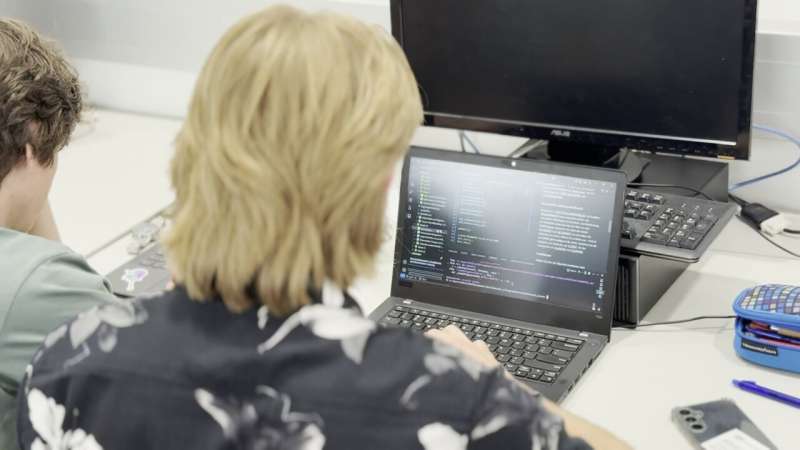
Artificial intelligence (AI) can now write entire computer programs. This creates a challenge for universities. How can students learn to program themselves if AI can do the work for them? Students need to know how to use AI tools well, but they must also understand how programs work and how to find and fix mistakes. To help with this, a team led by Christopher Albert at the Institute of Theoretical and Computational Physics at Graz University of Technology (TU Graz) has created a learning platform called "computor." Teachers are already using it, and it is also available to the public.
A digital tutor that does not give students the answers
The main part of the platform is an AI tutor named Lena. Lena is built into the programming environment and helps students when they get stuck on a task. It knows what task the student is working on and can see the code they have written so far. This helps it give useful advice. However, it is designed not to give students complete solutions.
"We want to encourage students to solve problems themselves, rather than simply relying on AI to provide the answer," explains Albert. Students should first learn basic programming skills, such as those needed to do physics calculations. Once they have these skills, they can learn to use AI more independently and think carefully about the answers it gives them.
"computor" also checks programs automatically to see whether they produce the expected results. For example, this feature is used in plasma physics courses. Before students can do certain laboratory experiments, they must use programs they have written themselves to calculate physical processes. The platform checks whether their results are correct. If it finds mistakes, it helps students work out how to fix them.
More time for discussions instead of routine checks
Automatic checking is also meant to reduce the workload for teachers. Using one central administration system, teachers can create their own courses, manage assignments and follow students' progress. They can see, for example, how many tries students need to solve a problem, whether they work on assignments regularly or wait until just before the deadline, and whether they finish many assignments unusually quickly. This helps teachers spot problems early and give students the support they need.
The aim is not to replace personal help from teachers. Instead, human tutors can spend more time discussing possible solutions and checking whether students really understand the subject. Students can also ask Lena for help while working on an assignment if a human tutor is not available right away. The AI tutor runs on TU Graz's own computer systems, so students do not need an account with a commercial AI service.

Learning to program, even outside university
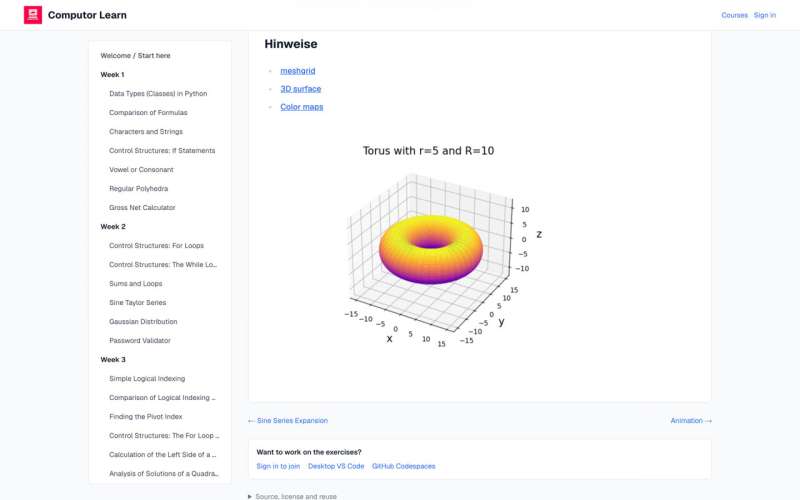
The "computor" team has also turned the platform into an open learning website that people can use in a web browser. Anyone who wants to learn programming can visit computor.at and use the programming tools without installing extra software. The platform's source code is also freely available as open-source software.
The platform is especially useful for people who need programming skills for natural sciences, engineering or data analysis. It already offers three free courses about data science using the Python programming language. Together, these courses contain 70 exercises. Universities, secondary schools and businesses can also use "computor" in their own courses and change the platform to fit what they teach.
Provided by Graz University of Technology
Who's behind this story?
Swati Mestri
Swati Mestri has a bachelor's degree in Electronics Engineering and has worked as a content editor since 2019. She has experience editing research papers and documents about technology, health care and materials science. She is especially interested in technology and space. Full profile →
Andrew Zinin
Andrew Zinin has a master's degree in physics and research experience. He has been interested in science news for many years and plays an important role in Science X's editorial work. Full profile →
Citation: computor: AI tutor as a programming learning aid (2026, November 19), retrieved 19 November 2026, from https://phys.org/news/2026-11-computor-ai-aid.html
This document is protected by copyright. Except for uses allowed under fair dealing rules for private study or research, no part may be reproduced without written permission. The content is provided for information purposes only.